
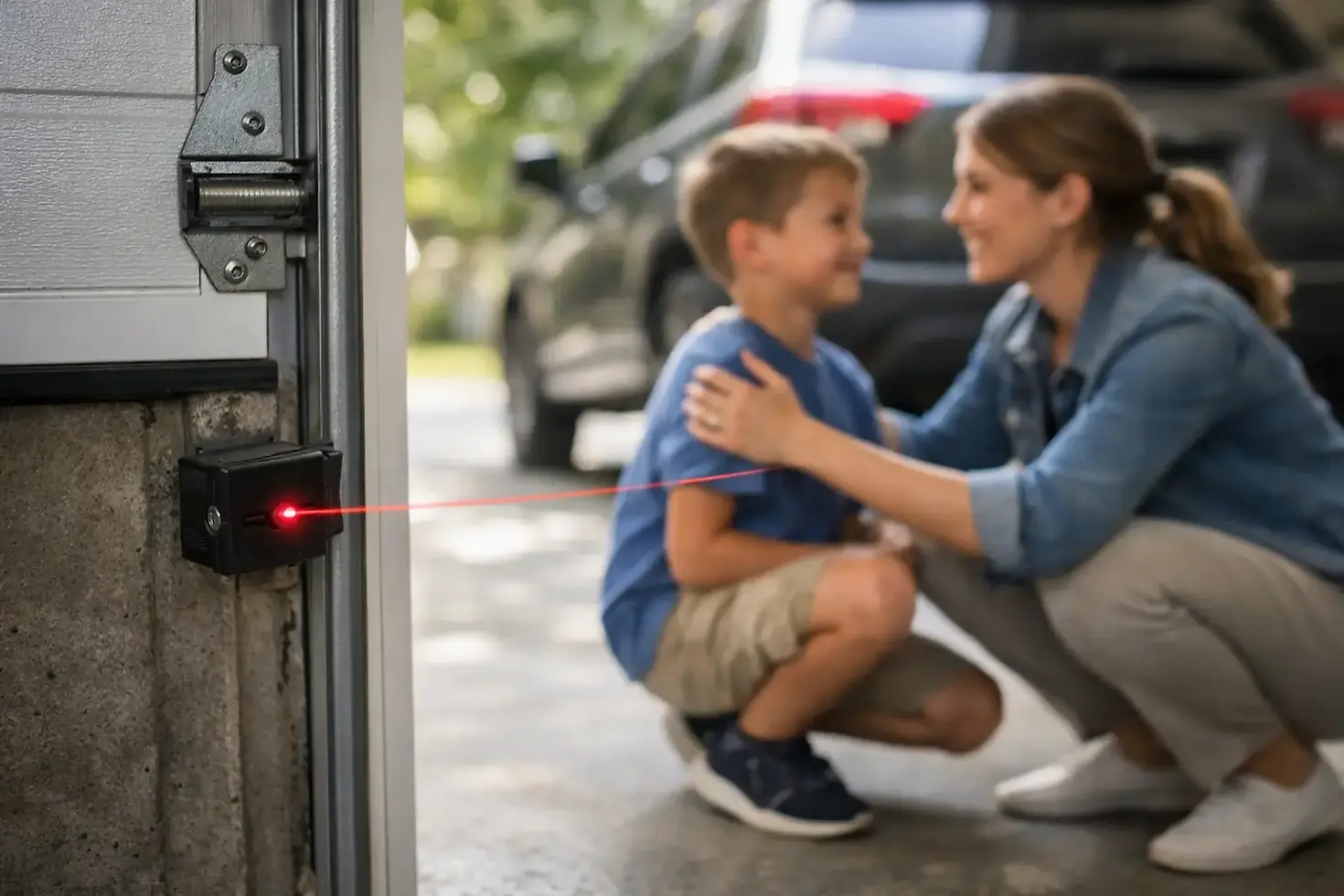
Garage Door Safety Sensors That Keep Families Safe
A garage door may be one of the largest moving parts of your home, yet it is often used without a second thought. Garage door safety sensors are there for the moments when a child runs back for a football, a pet wanders into the opening, or a car is not quite clear of the doorway. When the system is correctly installed and maintained, it should prevent the door from closing onto an obstruction and give your household real peace of mind.
For homes across the Costa Blanca, Costa Cálida and Alicante, reliable safety matters just as much as smooth automation. A made-to-measure roller garage door gives you security, kerb appeal and access at the touch of a button. Its safety equipment ensures that convenience does not come at the expense of your family, visitors or vehicle.
How garage door safety sensors work
Most automated garage doors use a pair of photoelectric sensors positioned low down on either side of the opening. One sensor sends an invisible beam across the entrance and the other receives it. If anything breaks that beam while the door is closing, the control system should stop the door and reverse it.
This is a simple principle, but it depends on accurate alignment, clean lenses, secure wiring and a properly configured motor. A sensor that is loose, knocked out of position or covered in dust may prevent the door from closing altogether. More concerningly, an old or poorly maintained system may not respond as it should.
Modern automated doors also commonly use force detection. The motor monitors resistance as the door travels and should stop or reverse if it meets an unexpected obstruction. This is useful additional protection, but it is not a replacement for correctly working photoelectric sensors. Force settings must be adjusted carefully: set too sensitively, the door may reverse during normal use; set too high, it may not react quickly enough to an obstruction.
Safety sensors are not just for new doors
If you have an existing automatic garage door, it may be possible to improve its safety features. Whether this is suitable depends on the door’s condition, motor, controls, wiring route and the available space around the opening. In some cases, upgrading the automation is the more sensible long-term option, especially where the current door is unreliable, poorly fitted or difficult to operate.
A professional assessment avoids spending money on a sensor kit that is not properly matched to the system. It also makes sure the finished installation looks tidy and performs reliably, rather than leaving exposed cables or equipment vulnerable to damage.
Why garage door safety sensors matter at home
The obvious benefit is protection against injury. Children do not always recognise that a closing door is hazardous, and dogs or cats can move through an opening faster than any adult can react. Sensors provide an automatic safeguard when someone presses a remote control from inside the house or arrives home with shopping, luggage or sports equipment.
They also help protect your car. Reversing into or out of a garage can be awkward when the driveway is narrow, the sun is low, or another vehicle is waiting behind you. A correctly operating sensor system can prevent a closing door from catching a roof rack, bike carrier, boot lid or bumper that has not fully cleared the opening.
For second-home owners, safety sensors are especially worthwhile. A property that stands empty for part of the year can collect dust, insects and garden debris around the garage entrance. Returning for a holiday is not the time to discover that the door will not close or that a sensor has been damaged. Regular maintenance helps keep the system ready when you need it.
There is a practical security benefit too. If the door repeatedly reverses or cannot close, it may leave the garage and its contents exposed. That does not mean sensors should ever be bypassed to get the door shut. It means the fault should be identified and corrected promptly.
A safe way to test your garage door
Homeowners can carry out a basic sensor check regularly, ideally once a month and after any work near the garage. Keep the test simple, and never use a person, pet, hand or foot as the obstruction.
With the opening clear, start by closing the door and interrupt the sensor beam using a long-handled object or a piece of cardboard. The door should stop and reverse without delay. Then check the contact reversal function using a solid block of timber placed flat on the floor in the path of the door. The door should reverse when it touches the block.
While testing, look for these common warning signs:
The door starts to close but immediately opens again.
One or both sensor indicator lights are off, flickering or a different colour from normal.
The door only closes when the wall control is held down continuously.
The system works in the morning but becomes unreliable in strong afternoon sunlight.
The door closes unevenly, makes unusual noises or appears to bind before it reaches the floor.
The first three symptoms can point to a blocked, misaligned or damaged sensor. Strong sunlight can occasionally interfere with an optical beam, depending on the direction of the garage and the sensor position. Uneven movement or noise may have a different cause, such as worn rollers, a damaged track, spring issues or a motor setting that needs attention. This is why diagnosis matters: replacing a sensor will not fix a door that is mechanically struggling.
Keep sensors clean, aligned and protected
Garage door safety sensors sit close to the ground, which makes them vulnerable to everyday knocks. A bicycle wheel, garden tool, child’s toy or even a careless sweep can move one sensor just enough to break the connection. In coastal and inland Spanish locations, wind-blown dust, insects and cobwebs can also build up on the lenses.
A soft, dry cloth is normally enough to clean the sensor lenses. Avoid abrasive products and do not spray water directly onto the units or wiring. Check that each sensor is firmly fixed, facing the other unit and not obstructed by stored items, plants or a new piece of trim around the doorway.
Do not adjust the motor force settings or dismantle electrical covers unless you are qualified to do so. It can be tempting to increase the force when a door reverses unexpectedly, but this may reduce a vital safety margin. The same applies to taping over sensors, disconnecting them or trying to bypass them temporarily. A garage door that closes is not necessarily a safe garage door.
When to arrange professional maintenance
A properly installed system should be checked as part of routine garage door maintenance. This is particularly valuable after heavy rain, building work, a vehicle impact, electrical issues or a long period when the property has been unoccupied.
During a professional visit, the technician can inspect sensor alignment and response, test the door’s reversing action, assess cables and brackets, check travel limits and examine the door’s mechanical operation. Preventative maintenance can identify small issues before they become a failed motor, damaged curtain, insecure garage or inconvenient call-out.
For a bespoke roller door, the safety system should be considered alongside the whole installation. The door needs to run smoothly in its guides, close accurately at the floor and work with controls that suit how your household uses the space. The Gate & Garage Door Company Spain takes this whole-system approach, from custom measurements and installation through to automation checks and aftercare.
A safe garage door should feel effortless to use, but that reliability is built on the details you rarely see. Test the sensors, keep the opening clear and act early if the door behaves differently. A prompt inspection is a small step that helps protect the people, pets and property behind your garage door.


Comments